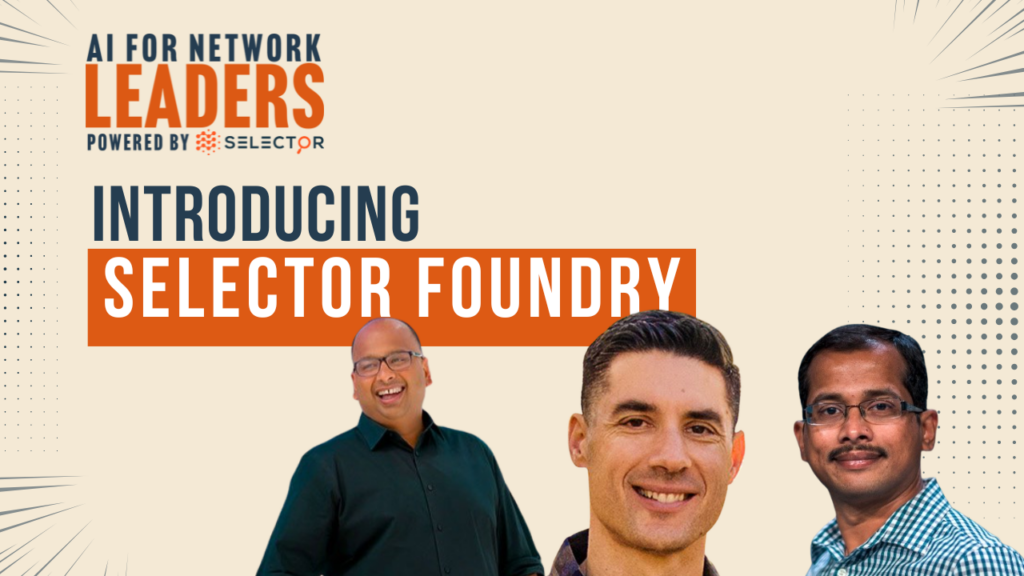
Nitin Kumar (CTO & Co-founder @ Selector), Surya Nimmagadda (Chief Data Scientist @ Selector), and Joby Rudolph (Senior Distinguished Engineer @ Selector)
If agentic AI in network operations is only as good as the data it reasons over, what does it actually take to build a foundation that agents can trust — and what happens when you turn that foundation loose on a live incident?
In this session, three members of Selector’s founding and engineering leadership walk through the evolution of their platform, from the original vision of a network that “talks to you” to a full fleet of specialized agents working alongside operators — closing with a live, end-to-end demo of an incident being investigated, visualized, fixed, and automated away.
They cover:
- Selector’s origin vision — a “social network” for infrastructure — and its evolution into Rosetta, a conversational agent, and now Agent Smith, a runtime for deploying a whole roster of agents on top of the data platform
- Why agentic AI without a strong data foundation just “hallucinates at high speed” — and Selector’s data-centric architecture: collection services, a “data hypervisor” that normalizes and enriches raw telemetry with customer-specific metadata, and machine learning models that build adaptive baselines rather than static thresholds
- How metrics, logs, and human-generated data (configs, maintenance emails) are each processed differently, then fused into a correlation graph that captures causation and cross-device blast radius
- The six core agents in Selector’s fleet — Rosetta (orchestrator), Loom (correlation/root-cause), Ticketmaster (ITSM integration), Herald (reporting/alerts), Artist (on-demand dashboard building), and Sculptor (an agent that builds other agents) — plus how the platform exposes its capabilities as MCP tools so custom agents and external MCPs (ServiceNow, PagerDuty, APM tools) can plug in
- A full live demo: an operator named Arvind investigates a P2 incident via natural-language conversation, gets an AI-generated root cause tied to a specific bad config change, builds a custom dashboard by describing it in plain English, checks for cross-system impact through an external APM integration, creates and extends a maintenance window, verifies the fix restored compliance, and finally uses Sculptor to spin up a background agent that will catch and flag similar bad configs automatically going forward
The throughline across all three talks: agentic AI succeeds or fails on the strength of the data and correlation work underneath it — the “boring” engineering of ingestion, normalization, and baselining is what makes the flashy conversational layer trustworthy enough to act on.