AI for Network Leaders — Powered by Selector

Join us in NYC on March 25th

AI for Network Leaders — Powered by Selector

Join us in NYC on March 25th

On this page

ChatOps for Network Operations with Selector

Nowadays, network operations engineers, planning engineers, and technology engineers are using a plethora of collaboration tools such as Slack and Microsoft Teams to share and collaborate on valuable information. The increase in distributed and virtual work environments — accelerated by the COVID-19 pandemic — has given rise to ChatOps for network operations, where collaboration happens directly in these messaging tools. Operations engineers now need to react quickly and communicate synchronously and asynchronously to identify the root cause of network problems.

The Challenge: Switching Between Tools Slows Teams Down

Traditionally, operations engineer had to leave their collaboration tools to access other applications and dashboards to find the data they needed. They would then copy and paste information back into Slack or Teams to share with the team — a time-consuming and inefficient workflow.

While some observability tools can post notifications into Slack or Teams, it’s still not the most effective or interactive method for network operations ChatOps.

Selector Brings Network Operations ChatOps to the Next Level

Selector has redefined ChatOps for network operations. By leveraging natural language queries and the Selector Analytics platform, any operations engineer can simply ask the platform a question within Slack or Teams and receive immediate answers in the same channel.

Key advantages include:

  • Answers are instantly visible to all team members in the channel.
  • No need to switch between tools or copy-paste data.
  • Multiple teams can interact with the Selector platform from their own collaboration channels, enabling cross-domain and cross-team collaboration.

Faster Troubleshooting and Reduced MTTR

Operations teams need to track Mean Time to Detect (MTTD) and Mean Time to Repair (MTTR) to assess network health. Both metrics improve when information flows quickly from the network to engineers and across teams.

By integrating Selector with Slack or Microsoft Teams, your teams can:

  1. Access real-time insights directly in your collaboration tool without logging into other interfaces.
  2. Use natural language queries to pull data even if they don’t know S2QL, Selector’s query language.
  3. Share insights instantly for faster decision-making and reduced MTTR.

Benefits of Selector’s Network Operations ChatOps Integration

  • Get answers where your team works — Slack or Teams — without workflow disruption.
  • Lower the information barrier with natural language queries.
  • Speed up detection and resolution by improving collaboration and context sharing.
  • Enable proactive, ChatOps-driven network operations for distributed teams.

See ChatOps for Network Operations in Action

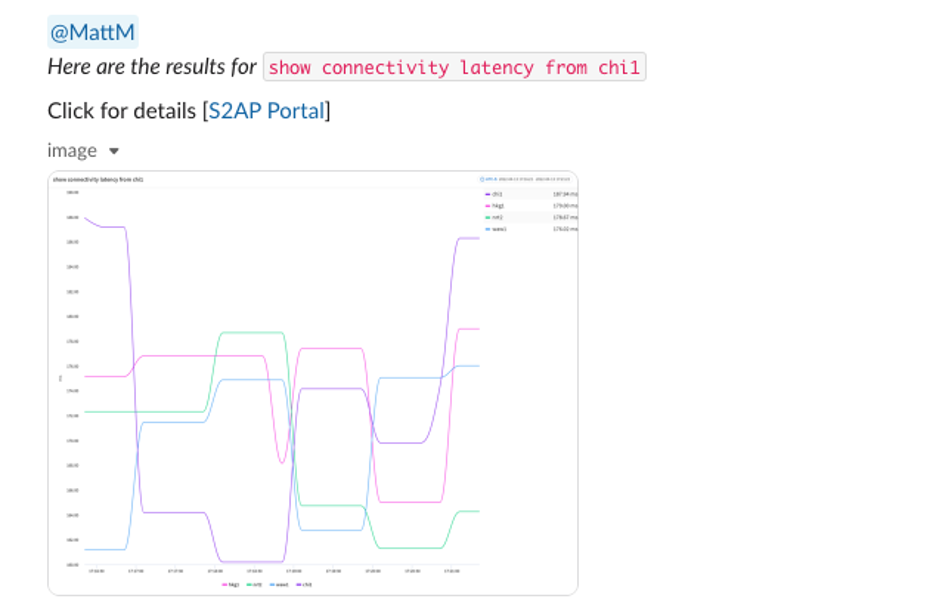
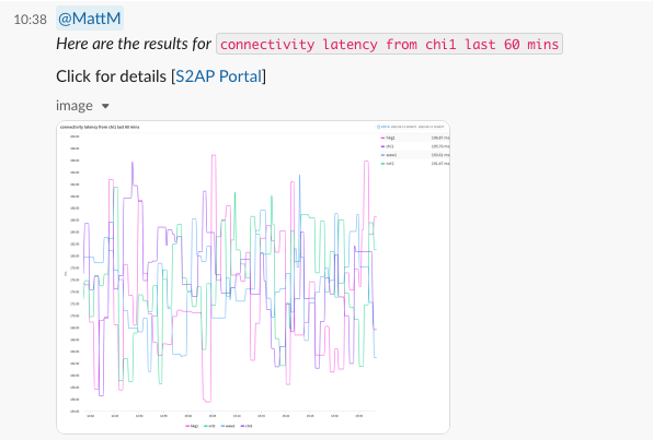
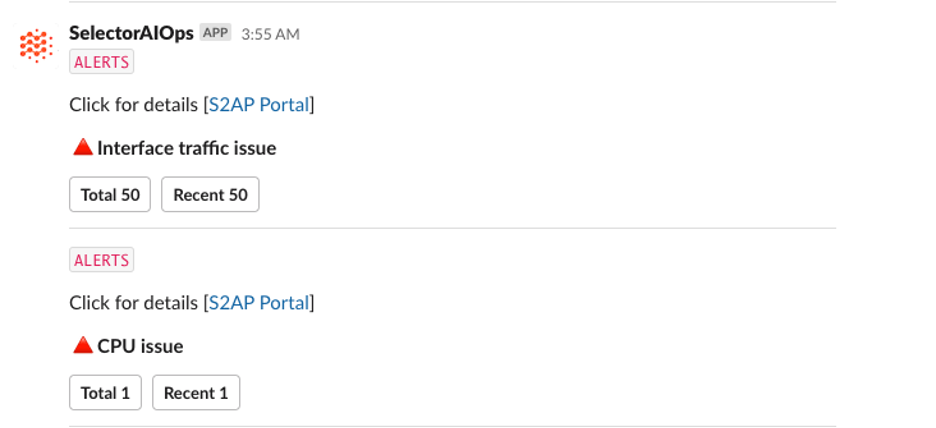
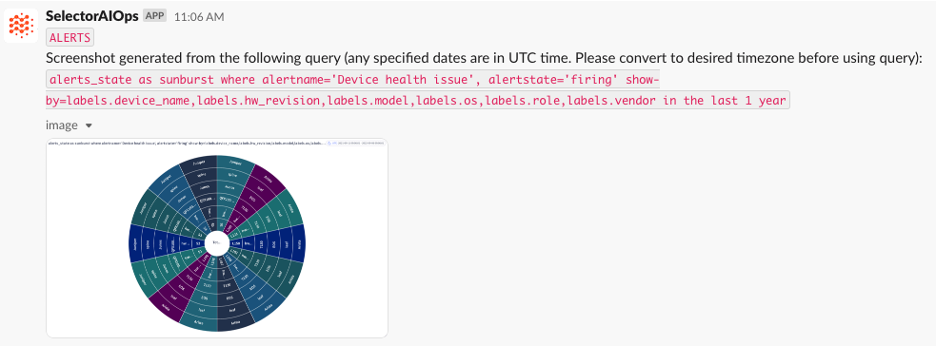
Below are several screenshots of this unique feature in Slack and Microsoft Teams:
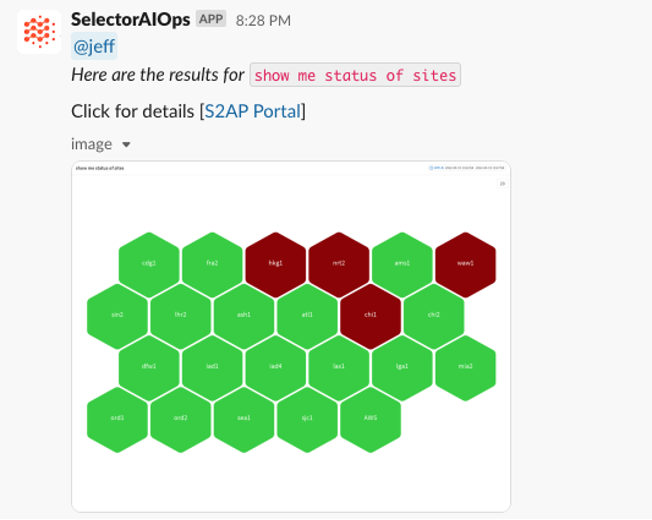
Operations engineer using Selector to perform natural language log query in Slack for faster troubleshooting.

Interested in learning more about this feature? Contact us today for a free demo!

More on our blog

Beyond the Dashboard: Selector’s Patented Approach to Conversational Observability

For years, IT operations teams have been trapped in a frustrating paradox: the data they need to solve critical issues is right at their fingertips, yet entirely out of reach. Accessing it requires engineers to master complex, platform-specific query languages, dig through endless layers of dashboards, and hunt for the exact visualization that holds the answer. Under the intense pressures of modern speed, scale, and complexity, this rigid model is breaking down. At Selector, we recognized a fundamental opportunity to change how teams interact with their data. Our recently published U.S. patent application (US20250278401A1, filed March 2, 2024, and published September 4, 2025), titled “Dashboard metadata as training data for natural language querying,” outlines a transformative solution. By utilizing dashboard metadata, aliases, and user interaction data as training material, we empower operators to bypass structured queries entirely and obtain infrastructure insights using plain, natu

The Business Case for AI-Driven Observability in Network Operations

Modern network operations generate an extraordinary amount of telemetry. Metrics, logs, events, topology data, cloud signals, and service context all contribute to a richer picture of system behavior. As environments expand across cloud, data center, edge, and SaaS, the opportunity for operations teams is clear: when that telemetry is unified and understood in context, it becomes a powerful source of resilience, efficiency, and business insight. That is why AI-driven observability has become such an important priority for IT and operations leaders. Its value comes from helping teams move through complex environments with greater clarity. Correlated signals, contextual awareness, and shared operational understanding help teams identify issues faster, coordinate more effectively, and resolve incidents with greater confidence. For business leaders, the conversation is increasingly practical. They want to understand how observability investments contribute to uptime, team productivity, op

Solving the Ticket Noise Problem: What We Learned from Our ServiceNow Webinar

On March 18th, we hosted a session focused on a challenge that continues to undermine even the most mature IT operations teams: ticket noise.  It’s easy to dismiss noise as just “too many alerts”. But as we explored in the webinar, the real issue runs deeper. Ticket noise is a symptom of something more fundamental — a lack of correlation, context, and shared visibility across the stack.  If you weren’t able to attend, this blog walks through the key ideas, examples, and takeaways. And if any of this feels familiar, it’s worth watching the full session.  View “Solving the Ticket Noise Problem: Bringing Intelligence to ServiceNow”.  The Hidden Cost of Tickets Most organizations don’t struggle because they lack monitoring. In fact, the opposite is true — they have too much of it. Over time, teams adopt specialized tools for every layer of the environment: Each tool does its job well within its domain, but incidents don’t respect those boundaries. As discusse

このサイトは開発サイトとして wpml.org に登録されています。remove this banner のキーを使用して本番サイトへ切り替えてください。