AI for Network Leaders — Powered by Selector

Join us in NYC on March 25th

AI for Network Leaders — Powered by Selector

Join us in NYC on March 25th

On this page

AIOps for Networking: See the Real Anomalies

AIOps quickly sorts through a maze of logs, telemetry, configuration changes, and other information to pinpoint the probable cause. Other approaches leave NetOps/SRE teams drowning in a sea of false alerts, different monitors, and static visualizations.

The Problem

There is a paradigm shift in the way services are delivered — monolithic applications moving to distributed applications spread across hybrid clouds. The excellent news about operations trends is that more devices and more endpoints are being monitored. The bad news is that systems that simply monitor metrics, create an operations nightmare.

Operations endpoints are physical, virtual, and functional (microservices). The number of endpoints is expanding at a rapid rate. A screen full of monitored endpoints is not observable by people.

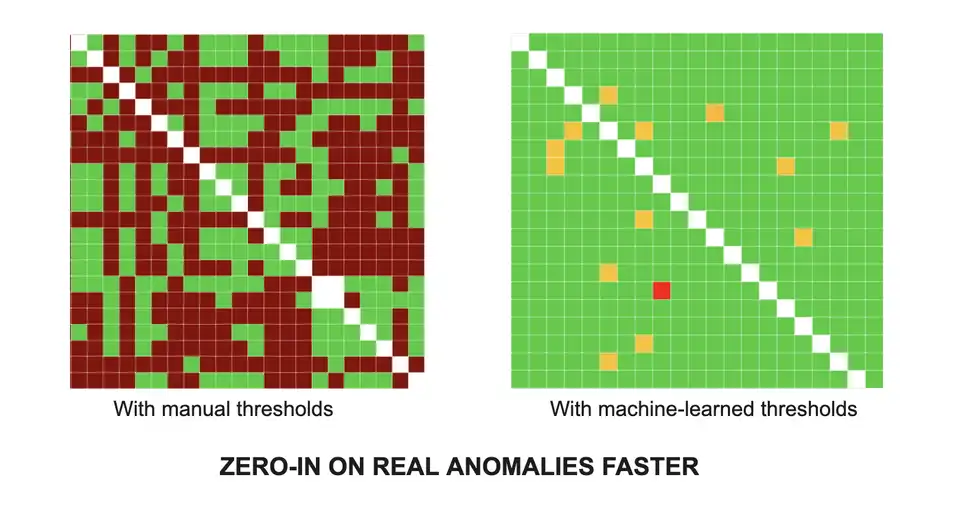
What about only reporting endpoints that have exceeded thresholds? In theory, this does reduce the number of alerts. In practice, most systems use static heuristics. All links should have X set as the threshold. All microservices should have Y set as the threshold. These heuristics, either vendor-supplied or manually configured by operations teams, generate false alarms. The appropriate threshold for one link, device, or microservice is not applicable for another. Worse still, operations teams have to accept the defaults set by vendors or set and maintain a rapidly growing number of thresholds.

The Selector AI Solution

Selector AI uses machine learning to set the appropriate threshold for each endpoint automatically. Endpoints do not have to be configured. Endpoints are identified in streaming data, and learning commences automatically. As thresholds are appropriately set for each endpoint, threshold violations are more realistic, the number of false alerts is dramatically reduced, and it is much easier and faster to see the real anomalies. Selector AI also identifies outliers in a distribution of similar endpoints.
Conclusion

Selector AI has proven in real production networks that AIOps machine learning dramatically reduces the time to see real anomalies by eliminating the false alerts that are generated by static thresholds that do not adjust to changing conditions, based on heuristics which are one-size fits all approaches. Selector AI eliminates the setup and maintenance of thousands of thresholds.

Selector AI also supports static & binary thresholds for those operations teams that still wish to use them in addition to Selector AI’s machine-learned baselining thresholds and visualizations.

More on our blog

The Business Case for AI-Driven Observability in Network Operations

Modern network operations generate an extraordinary amount of telemetry. Metrics, logs, events, topology data, cloud signals, and service context all contribute to a richer picture of system behavior. As environments expand across cloud, data center, edge, and SaaS, the opportunity for operations teams is clear: when that telemetry is unified and understood in context, it becomes a powerful source of resilience, efficiency, and business insight. That is why AI-driven observability has become such an important priority for IT and operations leaders. Its value comes from helping teams move through complex environments with greater clarity. Correlated signals, contextual awareness, and shared operational understanding help teams identify issues faster, coordinate more effectively, and resolve incidents with greater confidence. For business leaders, the conversation is increasingly practical. They want to understand how observability investments contribute to uptime, team productivity, op

Solving the Ticket Noise Problem: What We Learned from Our ServiceNow Webinar

On March 18th, we hosted a session focused on a challenge that continues to undermine even the most mature IT operations teams: ticket noise.  It’s easy to dismiss noise as just “too many alerts”. But as we explored in the webinar, the real issue runs deeper. Ticket noise is a symptom of something more fundamental — a lack of correlation, context, and shared visibility across the stack.  If you weren’t able to attend, this blog walks through the key ideas, examples, and takeaways. And if any of this feels familiar, it’s worth watching the full session.  View “Solving the Ticket Noise Problem: Bringing Intelligence to ServiceNow”.  The Hidden Cost of Tickets Most organizations don’t struggle because they lack monitoring. In fact, the opposite is true — they have too much of it. Over time, teams adopt specialized tools for every layer of the environment: Each tool does its job well within its domain, but incidents don’t respect those boundaries. As discusse

Cloud Observability Is Broken — Hybrid Operations Need a New Intelligence Model

Cloud adoption was supposed to simplify operations. Infrastructure would become programmable, scalability would become elastic, and distributed architectures would enable resilience at global scale. In practice, cloud has delivered extraordinary flexibility, but it has also introduced a level of operational complexity that traditional observability approaches were never designed to handle. Today’s enterprise environments are not simply “in the cloud.” They are hybrid ecosystems spanning multiple providers, regions, private infrastructure, edge locations, and interdependent network paths. Services operate across layers that are dynamically provisioned, continuously reconfigured, and often owned by different teams. Yet many organizations still approach cloud observability as if visibility alone is sufficient. It isn’t. The Visibility Paradox in Hybrid Cloud Environments Most enterprises have invested heavily in observability tooling. Metrics, logs, traces, flow telemetry, synthetic test

このサイトは開発サイトとして wpml.org に登録されています。remove this banner のキーを使用して本番サイトへ切り替えてください。