
AI in network operations is evolving faster than ever. But while new models and agents are emerging almost daily, they’re often working alone, with each confined to its own context, data, and domain. One model might analyze telemetry, another handles automation scripts, and a third generates summaries or recommendations.
Each model might be intelligent on its own, but without a way to share context, they end up thinking in isolation, limiting what they can achieve together.
The Coordination Problem in AI-Driven Operations
Modern operations rely on a growing web of AI models, tools, and APIs. But these components rarely speak the same language. Data pipelines feed one agent, while another operates on different metrics. Automation scripts are triggered without understanding the “why” behind an alert.
Without a common framework for coordination, every tool acts as if it’s the only one in the room.
That’s where the Model Context Protocol (MCP) comes in, and where Selector’s MCP Server redefines how AI agents reason, collaborate, and act across complex environments.
The “USB-C” of AI
MCP is often described as the USB-C of artificial intelligence — a universal connector that lets models, agents, and tools exchange context and coordinate actions through a common language.
Selector’s MCP Server brings that concept to life for real-world operations. It provides a secure, managed environment that enables Selector and external MCP clients or servers to communicate, exchange context, discover tools, and orchestrate decisions across systems that previously had no way to connect.
To put it simply: MCP makes Selector interoperable with the broader AI ecosystem, from IDE copilots and custom agents to cloud automation platforms.
What Makes Selector’s MCP Server Different
Selector’s MCP Server was built for interoperability, not isolation. It’s designed to extend the power of the Selector AI Platform (S2AP) beyond its own boundaries, connecting to third-party agents, reasoning frameworks, and developer tools through open, standards-based collaboration.
- Universal Context Layer: Establishes a shared protocol for exchanging context among agents, tools, and models.
- Agent-to-Agent Collaboration (A2A): Enables multi-domain reasoning where AI systems can coordinate decisions and share outcomes.
- Secure Streaming Architecture: Uses OAuth 2 and fine-grained RBAC to ensure only authorized systems can access Selector resources.
- Open Ecosystem Support: Integrates with IDEs and model providers, including VS Code, Gemini-CLI, Cursor, OpenAI, Anthropic, and more.
Instead of replacing existing systems, the MCP Server connects them, turning disconnected capabilities into a cooperative, context-aware network.
How It Works (in Plain English)
At its core, the Selector MCP Server acts as a translator and bridge between MCP clients (agents or applications) and tools or resources (APIs, automation, databases, reasoning modules).
- Agents connect to the MCP Server using OAuth credentials.
- The server exposes tools — such as automation workflows or analysis functions — through open MCP interfaces.
- Clients discover and invoke tools dynamically, exchanging context as they go.
- Selector’s managed MCP infrastructure scales elastically, ensuring secure, low-latency collaboration between clients across domains or environments.
Deployment is simple: provide your Selector instance URL and OAuth2 token, and any MCP-compatible agent can begin collaborating with Selector’s AI and data ecosystem.
Connected Intelligence in Action
The power of MCP becomes clear when you see how it ties the whole ecosystem together, from data sources and AI models to operational outcomes.
The Selector MCP Server connects all layers of the AI-driven operations landscape, enabling context-aware collaboration among tools that typically operate in isolation.
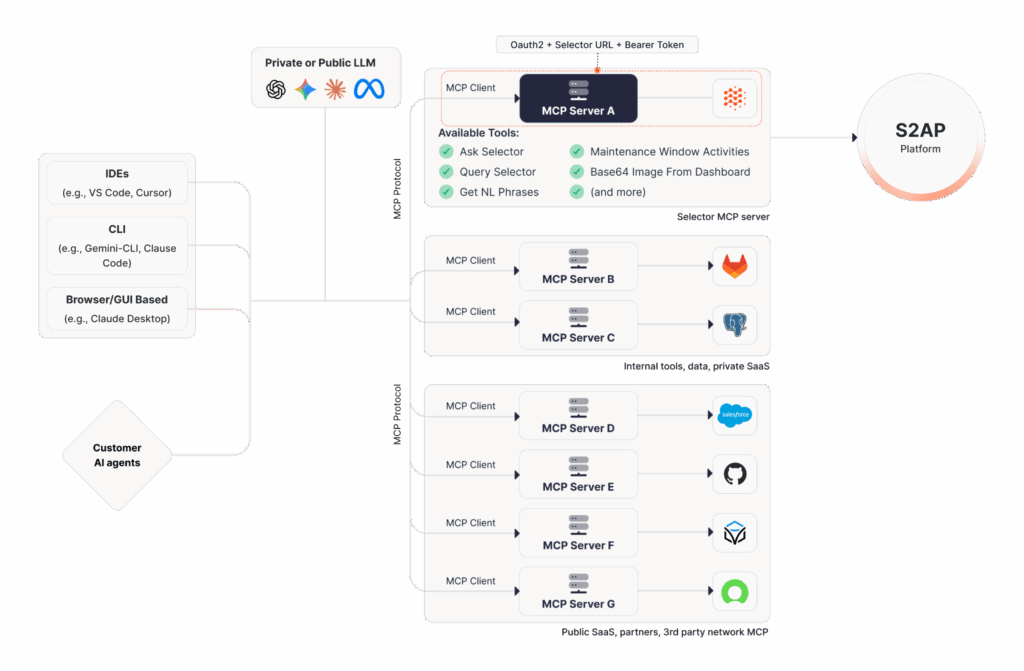
Where MCP Fits Within the Selector AI Platform (S2AP)
The Selector AI Platform (S2AP) remains the core — where data is ingested, correlated, and enriched for AIOps, RCA, and natural-language interaction. The MCP server builds on top of that foundation as an integration layer that extends Selector’s reach beyond its native environment.
- Expose Selector to the world: MCP lets external MCP clients or agents access Selector’s insights, telemetry, and automation tools securely.
- Bring external capabilities in: Connect IDE copilots, custom AI agents, or other MCP servers to Selector, letting them share reasoning and act on correlated data.
- Enable cross-system workflows: Events from Selector can trigger external tools, and vice versa, through a shared reasoning framework.
In essence, MCP makes S2AP collaborative. It allows the platform to participate in multi-agent ecosystems without changing how customers deploy or use Selector today.
From Single-Agent Tasks to Multi-Agent Workflows
With MCP in place, Selector users can evolve from isolated automations to connected intelligence. Agents can:
- Share context across NetOps, AppDev, and infrastructure domains.
- Correlate reasoning in real time for faster, more accurate RCA.
- Chain decisions across both Selector and external tools for closed-loop workflows.
This is how AI in operations shifts from automation to coordination.
Why It Matters
For network and IT teams, this means faster RCA, fewer silos, and more trustworthy operations. For business leaders, a clearer path to intelligent operations that adapt to changing environments. For the AI community, a practical framework for interoperability, one that connects specialized agents into something greater than the sum of their parts.
The Selector MCP Server isn’t about replacing existing tools, but rather about connecting them. It’s the bridge between your AI platform and the rest of the intelligent ecosystem.
As more systems adopt MCP, organizations that use Selector won’t be locked into a single AI framework. They’ll be part of a shared, open protocol for reasoning, collaboration, and automation.
Stay Connected
Selector is helping organizations move beyond legacy complexity toward clarity, intelligence, and control. Stay ahead of what’s next in observability and AI for network operations:
- Subscribe to our newsletter for the latest insights, product updates, and industry perspectives.
- Follow us on YouTube for demos, expert discussions, and event recaps.
- Connect with us on LinkedIn for thought leadership and community updates.
- Join the conversation on X for real-time commentary and product news.
Ready to see what modernization should really look like? Schedule a demo with our team.