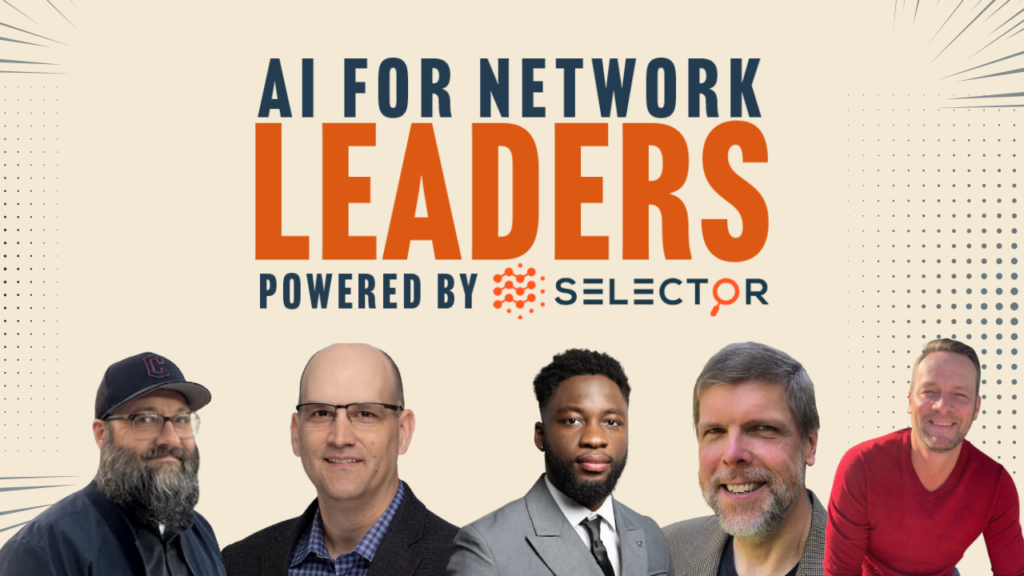
Live Q&A Panel: Building AI Into Network Operations
Featuring Scott Robohn (CEO @ Solutional · Co-founder @ Network Automation Forum), Greg Freeman (VP, Network and Customer Transformation @ Lumen), Disleve Kanku (Data Engineer II @ Dana-Farber Cancer Institute · Founder & CEO @ OncoSys AI), and Jason Gintert (Co-founder & President @ US Networking User Association)
With the model landscape shifting every few months, how do you build a roadmap — and a workforce — that can actually keep up?
In this closing panel, the day’s speakers took audience questions live, moving from tooling and timelines into the harder organizational and human questions around AI adoption in network operations.
They covered:
- How to keep learning when tools change faster than certifications can — using LLMs to learn LLMs, automating a “podcast pipeline” for passive learning, and placing a few strategic bets (like MCP) rather than chasing every new framework
- Realistic timelines for AI platform maturity — Lumen’s deterministic workflows took 2.5–3 months to build, but spec-driven design cut that to two days; most panelists converged on roughly 90 days to show POC value versus 6–12 months for full production rollout
- Why psychological and cultural ROI can matter as much as financial ROI when picking a first use case, to build internal buy-in
- Data normalization across merged, fragmented platforms — using per-source agents that report to a coordinating “mother agent,” confidence-scoring inconsistent naming conventions, and being pragmatic rather than trying to normalize everything at once
- Top risk factors named across the panel: complacency/laziness as trust in AI outputs grows, governance and data access (especially in healthcare), skills atrophy and over-reliance on AI answers, concentration of power in a small number of AI companies, and AI ethics around targeted persuasion
- Concerns about early-career workers losing the chance to develop critical thinking and problem-solving skills — and possible responses, including deliberate junior-senior pairing, stronger mentoring programs, and holding a higher bar for how much “raw AI” output is acceptable in team deliverables
- Where the panel sees things heading next: AI-to-AI communication becoming more common, the rising importance of gateways (for cost routing and model governance) and MCP as a connecting standard, and early movement toward distributed/edge inference
The session closed on a cautiously optimistic note: the tools will keep changing, but disciplined goal-setting, earned trust, and deliberate investment in people are what separate durable AI adoption from projects that stall out.