AI for Network Leaders — Powered by Selector

Join us in NYC on March 25th

AI for Network Leaders — Powered by Selector

Join us in NYC on March 25th

On this page

ChatOps for Network Operations with Selector

Nowadays, network operations engineers, planning engineers, and technology engineers are using a plethora of collaboration tools such as Slack and Microsoft Teams to share and collaborate on valuable information. The increase in distributed and virtual work environments — accelerated by the COVID-19 pandemic — has given rise to ChatOps for network operations, where collaboration happens directly in these messaging tools. Operations engineers now need to react quickly and communicate synchronously and asynchronously to identify the root cause of network problems.

The Challenge: Switching Between Tools Slows Teams Down

Traditionally, operations engineer had to leave their collaboration tools to access other applications and dashboards to find the data they needed. They would then copy and paste information back into Slack or Teams to share with the team — a time-consuming and inefficient workflow.

While some observability tools can post notifications into Slack or Teams, it’s still not the most effective or interactive method for network operations ChatOps.

Selector Brings Network Operations ChatOps to the Next Level

Selector has redefined ChatOps for network operations. By leveraging natural language queries and the Selector Analytics platform, any operations engineer can simply ask the platform a question within Slack or Teams and receive immediate answers in the same channel.

Key advantages include:

  • Answers are instantly visible to all team members in the channel.
  • No need to switch between tools or copy-paste data.
  • Multiple teams can interact with the Selector platform from their own collaboration channels, enabling cross-domain and cross-team collaboration.

Faster Troubleshooting and Reduced MTTR

Operations teams need to track Mean Time to Detect (MTTD) and Mean Time to Repair (MTTR) to assess network health. Both metrics improve when information flows quickly from the network to engineers and across teams.

By integrating Selector with Slack or Microsoft Teams, your teams can:

  1. Access real-time insights directly in your collaboration tool without logging into other interfaces.
  2. Use natural language queries to pull data even if they don’t know S2QL, Selector’s query language.
  3. Share insights instantly for faster decision-making and reduced MTTR.

Benefits of Selector’s Network Operations ChatOps Integration

  • Get answers where your team works — Slack or Teams — without workflow disruption.
  • Lower the information barrier with natural language queries.
  • Speed up detection and resolution by improving collaboration and context sharing.
  • Enable proactive, ChatOps-driven network operations for distributed teams.

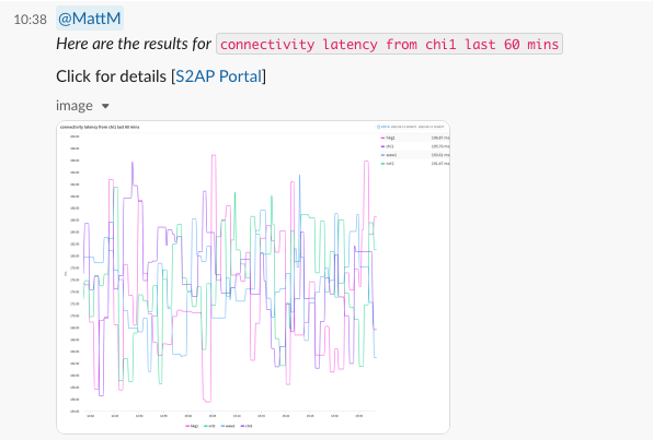
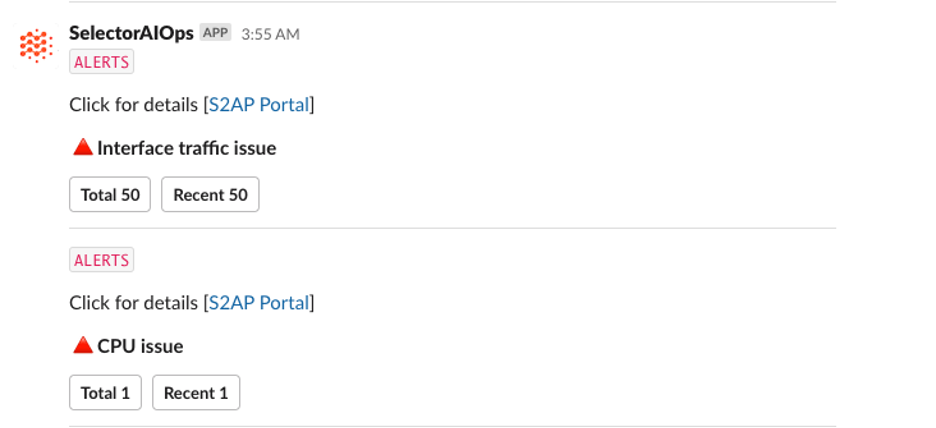
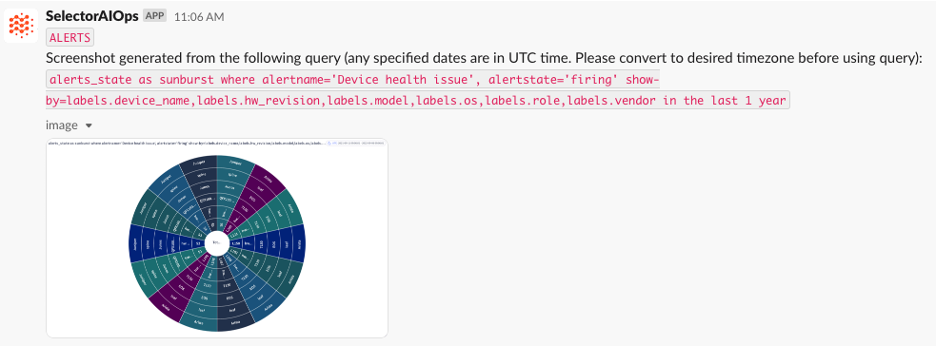
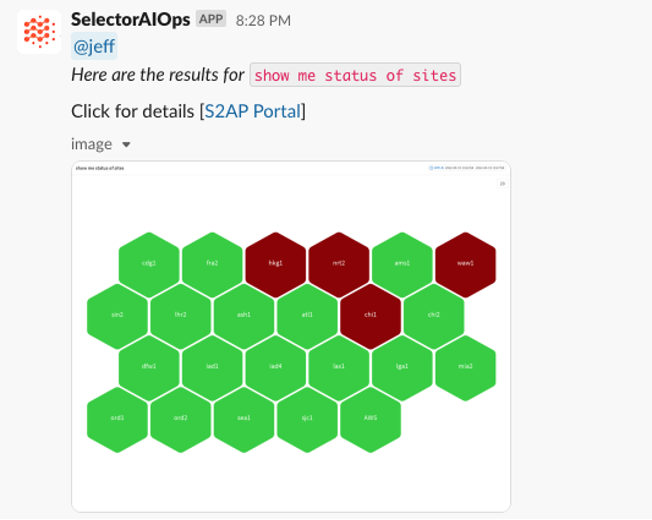
See ChatOps for Network Operations in Action

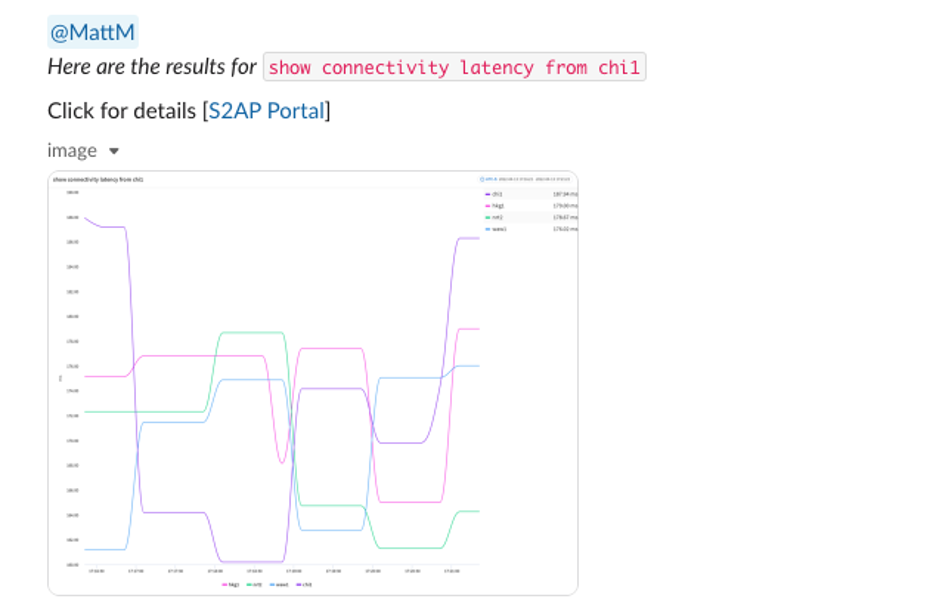
Below are several screenshots of this unique feature in Slack and Microsoft Teams:

Operations engineer using Selector to perform natural language log query in Slack for faster troubleshooting.

Interested in learning more about this feature? Contact us today for a free demo!

More on our blog

Cloud Observability Is Broken — Hybrid Operations Need a New Intelligence Model

Cloud adoption was supposed to simplify operations. Infrastructure would become programmable, scalability would become elastic, and distributed architectures would enable resilience at global scale. In practice, cloud has delivered extraordinary flexibility, but it has also introduced a level of operational complexity that traditional observability approaches were never designed to handle. Today’s enterprise environments are not simply “in the cloud.” They are hybrid ecosystems spanning multiple providers, regions, private infrastructure, edge locations, and interdependent network paths. Services operate across layers that are dynamically provisioned, continuously reconfigured, and often owned by different teams. Yet many organizations still approach cloud observability as if visibility alone is sufficient. It isn’t. The Visibility Paradox in Hybrid Cloud Environments Most enterprises have invested heavily in observability tooling. Metrics, logs, traces, flow telemetry, synthetic tests, and cloud-native monitoring capabilities generate unprecedented volumes of operational data. On paper, this should provide comprehensive visibility into system behavior. In reality, the opposite often occurs. Teams find themselves navigating fragmented dashboards and disjointed alert streams, each representing only a partial view of system state. A routing degradation may surface in network telemetry. A performance anomaly may appear in application metrics. A configuration drift may manifest in infrastructure logs. Individually, these signals are accurate. Collectively, they are ambiguous. This fragmentation creates what might be called the visibility paradox: more telemetry does not necessarily produce better operational insight. As hybrid architectures grow in scale and interdependence, outages rarely originate from a single component. They emerge from interactions between services, connectivity paths, and infrastructure layers. Understanding these interactions requires more than instrumentation. It requires context. Why Traditional Observability Models Fall Short Traditional observability frameworks were designed for relatively contained environments. They assume that system components can be monitored independently and that root cause can be inferred by analyzing deviations within each domain. Hybrid cloud environments invalidate these assumptions. Dependencies now extend across provider boundaries, network interconnects, and shared infrastructure layers. Performance degradations may originate in places where teams have limited visibility or control. Native cloud metrics may indicate healthy infrastructure even as user experience deteriorates along end-to-end delivery paths. This disconnect reflects a fundamental limitation: observability tools often analyze signals in isolation rather than preserving the relationships between them. As a result, operational teams must manually reconstruct context during incidents, slowing resolution and increasing risk. The operational burden shifts from interpreting system behavior to stitching together telemetry. Shifting From Observability to Operational Intelligence To address this challenge, organizations must evolve beyond traditional observability toward what might be described as operational intelligence. Operational intelligence is defined not by the quantity of telemetry available, but by the ability to understand how systems behave as interconnected ecosystems. It emphasizes correlation, dependency awareness, and causal reasoning over raw data collection. In hybrid cloud environments, this means: This shift fundamentally changes how incidents are investigated. Instead of reacting to alerts and validating assumptions manually, teams can operate with contextual awareness that guides decision-making from the outset. The Network Is the Missing Dimension of Cloud Operations One of the most persistent misconceptions in cloud operations is that infrastructure abstraction reduces the importance of network visibility. In reality, distributed cloud architectures make connectivity more critical than ever. Application performance often depends less on the health of individual resources and more on the reliability of the paths connecting them. Cross-region latency, interconnect failures, routing misconfigurations, and provider performance variability can all degrade service delivery even when underlying compute and storage resources appear stable. Without end-to-end path awareness, these issues are difficult to detect and diagnose. Operational intelligence frameworks address this gap by integrating network telemetry into broader observability models. By preserving path-level context alongside infrastructure and application signals, teams gain a more accurate representation of service health. This integrated perspective is essential for achieving true resilience in hybrid environments. Rethinking Capacity, Resilience, and Provider Strategy Hybrid cloud complexity also introduces new challenges in capacity planning and resilience engineering. Decisions about resource allocation, traffic routing, and provider selection increasingly depend on dynamic performance characteristics rather than static architectural assumptions. Operational intelligence enables more informed decision-making by analyzing utilization patterns and performance trends across regions and providers. Organizations can identify inefficiencies, anticipate bottlenecks, and optimize infrastructure investments based on empirical insights rather than reactive adjustments. Similarly, comparative visibility into provider performance supports more sophisticated resilience strategies. Enterprises can diversify critical service paths, mitigate dependency risks, and adapt to changing conditions with greater confidence. In this context, observability becomes a strategic capability rather than a purely technical one. The Future of Cloud Operations Is Context-Driven Hybrid cloud environments will continue to grow in scale and complexity. Emerging paradigms such as multi-cloud orchestration, edge computing, and AI-driven services will introduce additional layers of interdependence. Operational success will increasingly depend on the ability to understand system dynamics holistically. Organizations that remain reliant on fragmented observability models may find themselves constrained by reactive workflows and prolonged incident resolution cycles. Those that adopt intelligence-driven approaches will be better positioned to maintain service reliability and support innovation. The evolution from observability to operational understanding represents a broader shift in how enterprises manage digital infrastructure. It reflects a recognition that modern systems behave less like collections of components and more like interconnected ecosystems. In such environments, context is not a luxury. It is the foundation of effective operations. Stay Connected Selector is helping organizations move beyond legacy complexity toward clarity, intelligence, and control. Stay ahead of what’s next in observability and AI for network operations: 

Full-Stack Observability Is Becoming a Business Imperative

As enterprises accelerate digital transformation, technology performance has become inseparable from business performance. Customer experiences, revenue streams, and operational efficiency increasingly depend on the reliability of complex, distributed systems. In this environment, full-stack observability is no longer a technical aspiration — it is a strategic necessity. The Fragmentation Challenge Historically, organizations adopted specialized tools to monitor different layers of their technology stack. Network monitoring platforms, infrastructure management systems, and application performance tools each provided valuable insights within their domains. However, modern architectures have blurred the boundaries between these domains. Cloud-native applications rely on interconnected services, dynamic infrastructure, and globally distributed networks. Failures rarely occur in isolation. Instead, they propagate across layers, creating diagnostic challenges that siloed tools cannot easily resolve. Fragmented visibility leads to prolonged outages, inefficient troubleshooting, and increased operational risk. Toward a Unified Operational Model Full-stack observability addresses these challenges by integrating telemetry across domains and constructing holistic representations of system behavior. By correlating signals from network, infrastructure, and application layers, organizations gain a comprehensive understanding of how services function in real time. This unified perspective enables teams to detect anomalies earlier, trace root cause more effectively, and respond to disruptions with greater precision. It also supports strategic initiatives such as hybrid cloud adoption and platform engineering. As systems become more modular and dynamic, end-to-end visibility becomes essential for maintaining operational coherence. Observability as a Driver of Business Outcomes The benefits of full-stack observability extend beyond technical metrics. Improved system reliability translates into tangible business outcomes, including reduced downtime costs, enhanced customer satisfaction, and more predictable service delivery. Moreover, observability data informs architectural decision-making. By analyzing performance patterns and dependency relationships, organizations can optimize resource allocation and prioritize investments in resilience. In this sense, observability becomes a source of competitive advantage. From Data Collection to Contextual Intelligence Achieving full-stack observability requires more than aggregating telemetry. The true value lies in contextualizing data and transforming it into actionable insights. Advanced analytics and machine learning play a critical role in this process, enabling organizations to identify patterns that would otherwise remain hidden. As digital ecosystems continue to evolve, the ability to interpret system behavior holistically will determine operational success. Preparing for the Next Phase of Digital Complexity The trajectory of enterprise technology suggests increasing interconnectedness and scale. Emerging paradigms such as edge computing, AI-driven services, and multi-cloud architectures will further complicate operational landscapes. Organizations that invest in full-stack observability today will be better prepared to navigate this complexity. They will possess the visibility and intelligence required to maintain performance, support innovation, and adapt to changing market conditions. In an era defined by digital dependence, observability is not simply a technical capability. It is a foundational element of business resilience. Stay Connected Selector is helping organizations move beyond legacy complexity toward clarity, intelligence, and control. Stay ahead of what’s next in observability and AI for network operations:  Join the conversation on X for real-time commentary and product news.
AI Agents in IT Operations: From Concept to Practical Value

Artificial intelligence has been a defining theme in IT operations for nearly a decade. Early AIOps initiatives focused on predictive analytics and anomaly detection, promising to reduce operational overhead and improve system reliability. While these capabilities delivered incremental value, they often fell short of transforming how operations actually functioned. Today, a new wave of innovation is redefining what AI can achieve in operational contexts: intelligent agents capable of reasoning, collaborating, and acting within complex systems. Moving Beyond Static Automation Traditional automation relies on predefined workflows and deterministic logic. While effective for routine tasks, these approaches struggle to adapt to unpredictable system behavior. Modern digital environments generate conditions that cannot always be anticipated or codified in advance. AI agents address this challenge by combining machine learning with contextual reasoning. They can interpret signals across domains, infer system state, and dynamically determine appropriate actions. This flexibility allows them to operate in environments characterized by volatility and scale. Rather than replacing human operators, AI agents augment their capabilities. Enhancing the Incident Lifecycle Incident response remains one of the most resource-intensive aspects of IT operations. Engineers must rapidly gather data, evaluate competing hypotheses, and execute remediation steps under pressure. This process is prone to delays and inconsistencies, particularly in large-scale environments. AI agents streamline each phase of this lifecycle. They continuously analyze telemetry, identify emerging patterns, and provide recommendations grounded in system context. In some cases, they can initiate corrective actions autonomously, reducing time to resolution and minimizing service impact. The result is a shift from reactive firefighting to proactive operational management. Maintaining Context in Complex Systems One of the defining advantages of AI agents is their ability to preserve situational awareness over time. Human operators may struggle to track evolving conditions across multiple incidents and system layers. Agents can maintain a persistent understanding of system dynamics, enabling more coherent responses to cascading failures. This continuity also supports knowledge retention. Operational insights that would otherwise remain tacit can be encoded into agent reasoning processes, reducing reliance on individual expertise. Scaling Operations in the Era of Digital Expansion As enterprises expand their digital footprints, operational complexity grows exponentially. New services, platforms, and integrations introduce additional points of failure and increase event volume. Traditional staffing models cannot scale indefinitely to meet these demands. AI agents provide a mechanism to extend operational capacity without proportional increases in headcount. By automating cognitive tasks and orchestrating workflows, they enable teams to manage larger environments more effectively. Building Trust Through Transparency Despite their potential, AI agents must be implemented thoughtfully. Transparency and explainability are essential for fostering trust among operational teams. Engineers need visibility into how agents derive recommendations and confidence that automated actions align with organizational priorities. Organizations that prioritize human-centric AI design will be better positioned to realize long-term value. Over time, as trust increases, agents can assume greater responsibility within operational workflows. The evolution of IT operations will not be defined by the replacement of human expertise, but by its amplification. AI agents represent a step toward operational models that combine machine precision with human judgment — a partnership that will shape the next generation of digital infrastructure management. Stay Connected Selector is helping organizations move beyond legacy complexity toward clarity, intelligence, and control. Stay ahead of what’s next in observability and AI for network operations: 
This site is registered on wpml.org as a development site. Switch to a production site key to remove this banner.