


Executive summary
ServiceNow doesn’t create ticket noise. It inherits it.
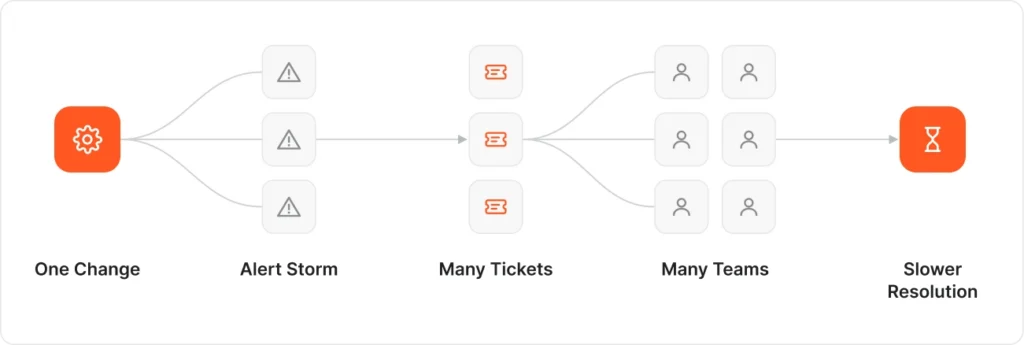
A network change is made in the early morning hours. Minutes later, users begin experiencing outages. Alerts fire across the environment. Network monitoring detects interface instability, infrastructure tools flag device health issues, application teams see service degradation, and cloud and operations teams begin receiving their own warnings. Each system sees a different symptom, and each system pushes its own version of the problem into ServiceNow.
What should be one incident becomes dozens of tickets.
Now, multiple teams move in parallel without shared context. The network team sees one set of alarms. Engineering sees another. SRE sees the downstream impact. Application owners get pulled in because customer-facing services are affected. ServiceNow becomes the place where all that noise accumulates, but not necessarily where clarity begins. Teams are forced to ask the same question under pressure: what actually changed? Which systems are impacted? Which ticket reflects the root cause, and which ones only reflect downstream effects?
This is the gap Selector is built to solve.
Without correlation, ServiceNow inherits fragmented signals instead of complete incidents. The result is not just alert fatigue, but operational drag. Engineers spend critical time reconstructing context across dashboards and consoles. Multiple teams investigate the same event from different angles. Duplicate tickets create duplicate assignment paths, duplicate updates, and duplicate effort. Mean time to resolution rises while the outage continues and the business waits for teams to determine what actually went wrong.
The cost compounds quickly. More ticket volume means more workflow overhead inside ServiceNow. More fragmented incidents mean more analyst time spent managing records, reassigning ownership, adding updates, and sorting through symptom-level noise. Skilled teams spend more time interpreting and less time restoring service. What appears to be a ticketing problem is actually a failure to correctly define incidents before they reach ServiceNow.
Why traditional monitoring-to-ServiceNow workflows break down
ServiceNow is highly effective at managing incidents, but it can only work with the incident data it receives. In most environments, monitoring systems operate within their own domains. Network tools detect network conditions. Infrastructure platforms track device and system health. Application monitoring surfaces service impact. Cloud tools report changes in their own layer. Each platform generates alerts based on its own logic and sends them downstream as separate events. By the time those events arrive in ServiceNow, they have already been fragmented.
Tickets are often created too early, before related signals have been evaluated together, before dependencies have been understood, and before the full scope of the issue is clear. Each ticket may be technically accurate, but operationally incomplete. ServiceNow ends up managing symptoms instead of incidents.
Duplicate tickets
Multiple tickets describing the same problem from different perspectives.
Unclear ownership
Ownership is unclear across teams.
Slower triage
Context must be assembled manually before triage can begin.
Longer MTTR
Teams work in parallel without a shared view.
Greater process load
Duplicate and low-context incidents move through the ServiceNow workflow.
At this scale, this creates a widening gap between event volume and operational understanding. The issue is not that there is too little data, but that too much of the data arrives without correlation, context, or incident-level understanding.

A new approach: correlated incident intelligence before ticket creation
Selector changes the workflow before ticket noise takes shape. Instead of passing every alert directly into ServiceNow as an isolated event, Selector ingests telemetry across the environment and evaluates it as a connected operational system. Signals across network, infrastructure, application, and cloud domains are correlated based on shared cause, timing, dependency, and impact. What reaches ServiceNow is no longer a flood of disconnected symptoms, but a clearer representation of the actual incident behind them.
This is the Selector difference: incident intelligence before incident creation.
Selector identifies when many alerts are really one issue. It preserves the relationships between events, recognizes when downstream symptoms point back to the same root cause, and delivers that understanding into the ITSM so teams can begin with a better incident record, not a collection of partial clues.
Instead of triaging a pile of loosely related tickets, teams can work from fewer, more complete incidents. Instead of creating duplicate records for the same problem, Selector can update the existing incident as conditions evolve. Instead of forcing engineers to leave the workflow and gather context across tools, Selector brings operational detail, timeline information, affected systems, and incident state into the record itself.
The result is sharper triage, clearer ownership, lower ticket volume, and faster movement from detection to root cause. ServiceNow remains the system where teams manage response, but Selector improves what enters that system in the first place.

How Selector changes the ServiceNow workflow
Bi-directional integration across the full incident lifecycle
Most monitoring-to-ITSM integrations are one-way streets. Alerts flow into the ITSM, and the operational context that lives inside the monitoring platform is never reconciled with what happens to the incident afterward. Selector’s integration is built differently.
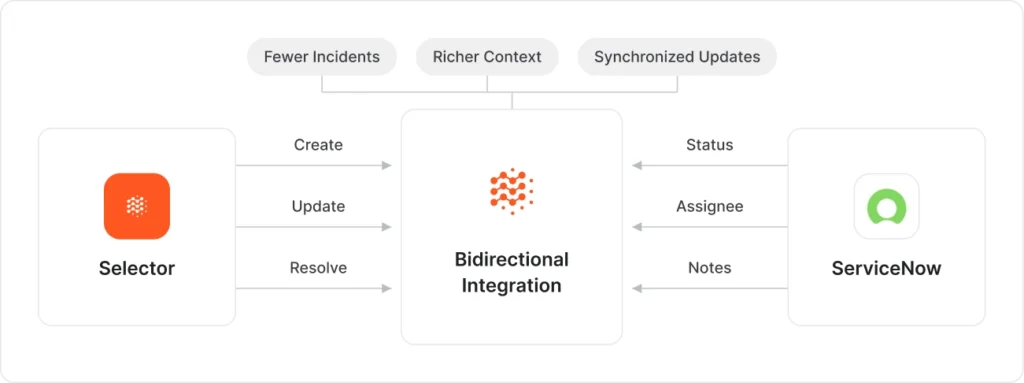
Using ServiceNow’s REST API framework, Selector maintains a continuously synchronized operational state across both platforms throughout the full incident lifecycle, not just at the moment of ticket creation.
When Selector’s correlation engine identifies a qualifying incident, it creates a ServiceNow record populated with correlated operational data: affected device identifiers, site and topology context, event timestamps, priority mapped from alert severity configuration, and structured work notes containing root-cause evidence. As the incident progresses inside ServiceNow, state changes — including closure codes, resolution notes, and status transitions — are synchronized back into the corresponding Selector incident record so both systems remain aligned.
The synchronization works in both directions. Engineers can modify incident priority, append work notes, update state, or trigger closure from within the Selector platform, and those changes are reflected in the customer’s ServiceNow instance without requiring the engineer to switch tools.
Because every ServiceNow deployment carries its own field schema, custom tables, and workflow configurations, the integration supports per-customer field mapping. Incident identifiers remain preserved across both systems, ensuring that a ticket created by Selector and later updated by a ServiceNow analyst remains traceable as a single unified record, regardless of which platform drives the next action.
No restructuring of existing ServiceNow processes is required. The integration conforms to the customer’s operational model, not the other way around.
Intelligent ticket deduplication
In high-volume environments, the same underlying condition can trigger repeated alerts across monitoring cycles. An interface may flap, stabilize, and recur. A degraded link may produce intermittent packet loss. A device may oscillate between reachable and unreachable states before the underlying issue is fully resolved. Without deduplication logic, each recurrence creates a new ticket, fragmenting incident history and multiplying analyst workload.
Selector addresses this through incident-aware alert grouping. Before creating a new ServiceNow record, Selector checks whether an open incident already exists for the same correlated condition, scoped by device, site, or region, depending on how correlation rules are configured. If a matching open incident is found, Selector updates the existing ticket rather than creating a new one. The new alert occurrence is appended with its timestamp, updated metric values, and current correlation context as a structured work note.
This preserves a continuous, chronological record that reflects how the condition evolved — when it first appeared, how frequently it recurred, and when it finally resolved — rather than scattering that history across disconnected tickets. The result is a ServiceNow queue that reflects the true number of distinct problems in the environment, not the raw volume of alert events.
From L1 ticket creation to L2 ticket enrichment
In many operations environments, ticket creation and deeper investigation happen in separate stages. An L1 workflow often creates a ticket from symptom-level alerts, while the assigned engineer must then gather additional context across monitoring systems before meaningful triage can begin.
Selector helps compress that handoff. Instead of creating tickets from isolated symptoms, Selector creates them from correlated alerts and enriches them with additional operational detail as part of the workflow. Ticket records can be updated with affected devices, timestamps, state changes, priority, comments, work notes, and broader context derived from related events and observed behavior across the environment.
Instead of starting from a low-context ticket that simply announces a problem, engineers begin with a more complete operational record that improves triage quality and shortens the path to resolution. Selector doesn’t just open the ticket; it also improves the quality of the investigation handoff.
Reducing ticket noise from planned changes and cross-domain visibility gaps
One of the most operationally costly and least discussed sources of ServiceNow noise is planned changes that adjacent teams are unaware of.
A network team may execute an approved maintenance window – a BGP policy update, a firmware upgrade on a core switch, an MPLS path reconfiguration, or a routing protocol timer adjustment – while application, infrastructure, and cloud teams observe only the resulting service degradation through their own monitoring tools. Without shared context linking downstream symptoms to the originating change event, each affected team generates its own alerts. ServiceNow inherits a burst of symptom-level tickets that are technically accurate but operationally redundant.
Selector reduces this pattern by correlating signals across domains and preserving broader operational context before those signals are handled as isolated records. By associating downstream alert bursts with the larger event that caused them – whether a planned change, a known recurring condition, or a propagating fault – Selector helps prevent duplicate ticket creation and gives teams a clearer starting point for determining whether they are responding to an active service-impacting fault or the expected effects of a change already in progress.
The outcome is a more accurate incident queue, less time spent closing tickets that should never have been opened, and better cross-team alignment without relying on manual communication to bridge the visibility gap between domains.
Extending context through CMDB and inventory alignment
Selector’s ServiceNow integration extends beyond incident creation to support CMDB-related and inventory synchronization workflows.
In many environments, device, site, and configuration data are spread across multiple systems, making it difficult to maintain a consistent operational context across teams and processes. Selector helps support that alignment by surfacing device, site, and configuration context through the ServiceNow integration, including workflows that associate affected infrastructure with the relevant records inside ServiceNow.
When a Selector-generated ticket references impacted devices or services, those relationships can be linked to existing configuration records, improving traceability between the operational issue and the corresponding assets in ServiceNow. For organizations that rely on CMDB data to support impact assessment, change review, and operational reporting, this reduces the manual effort required to reconcile ticket context with the underlying infrastructure record.
This extends the value of the integration beyond queue management alone. It helps connect incidents to the infrastructure context teams already use to understand operational impact.
Reducing the cost of IT operations
The cost of a network incident extends well beyond the outage itself. Every unresolved alert that reaches an ITSM platform as a fragmented, low-context ticket carries a compounding operational cost: analyst time spent on manual triage, L2 investigation hours reconstructing context across disconnected dashboards, duplicate records consuming workflow capacity, and automation or AI resources spent on incidents that could have been prevented, consolidated, or resolved before they entered the queue. With downtime often estimated at $5,600 per minute (Gartner), the financial impact of slower resolution adds up quickly.
Selector reduces that cost at every layer. By correlating alerts before they become tickets, Selector can help reduce raw incident volume by up to 60%, lowering the number of issues that require human attention, workflow overhead, and downstream processing inside ServiceNow. By enriching incidents with investigation-ready operational data, Selector can help reduce mean time to resolution by up to 85%, shortening the time required to understand, triage, and resolve each event. By suppressing noise from planned changes and recurring known conditions, Selector helps ensure teams and automation focus on real operational issues rather than on redundant records, false positives, and unnecessary AI-assisted ticket processing.
Just as important, Selector delivers those gains without requiring organizations to rework the ServiceNow operating model they already rely on. The integration is designed to fit into existing ServiceNow environments, supporting incident retrieval, creation, and updating, as well as related workflow automation, while preserving the customer’s field schema, workflow logic, assignment structures, and operational processes. Organizations do not need to replace ServiceNow, redesign their incident workflows, or force teams into a new system of record in order to improve incident quality.
That makes adoption both practical and valuable. Teams can continue working inside the operational framework they already know, while improving the quality of what enters it. The result is not simply more intelligence added to IT operations, but less waste across people, processes, and platform spend — delivered in a way that aligns with how ServiceNow already works within the organization.

Beyond ServiceNow
Although this brief is centered on ServiceNow as the leading enterprise ITSM platform, the same integration model and operational value extend to other ITSM tools as well. Selector improves incident quality upstream of the ticketing system itself – correlating related signals, reducing duplicate records, enriching incidents with investigation-ready context, and synchronizing updates across the incident lifecycle. As a result, organizations can realize the same benefits of reduced noise, faster resolution, and more efficient operations across virtually any ITSM environment.

From ticket volume to incident clarity
As environments grow more interconnected, the challenge is no longer generating enough operational data. The challenge is determining which data belongs together before it becomes actionable.
Selector helps ServiceNow workflows begin with better incidents: fewer duplicates, richer context, synchronized lifecycle data, and a clearer path to root cause. Instead of forcing teams to reconstruct operational truth from fragmented alerts, Selector gives them a more complete incident at the moment response begins.
For organizations trying to reduce noise, lower operational overhead, and improve MTTR, the value of ServiceNow integration lies not simply in creating tickets but in ensuring the right incident reaches ServiceNow in the first place.